
Over the years, Neolex has committed to sustainability. This isn’t just to save money, but also to truly improve how efficient its production is and how well it performs environmentally. Neolex always pays special attention to choosing the right raw materials and to using water and energy as efficiently as possible. From an environmental perspective, these three areas are the most critical parts of the whole manufacturing process.
Sanitaryware Manufacturing Process
Sanitaryware is an essential part of modern bathrooms—made through a highly controlled industrial process that ensures durability, hygiene, and long life.
Table of Contents
1. Raw Materials
2. Body Preparation
3. Mould Preparation
4. Casting Process
5. Drying Process
6. Finishing
7. Glazing Process
8. Firing Process
9. Sorting Process
10. IAPMO Standard Testing & Quality Control
11. Packaging
12. Dispatch
FAQ
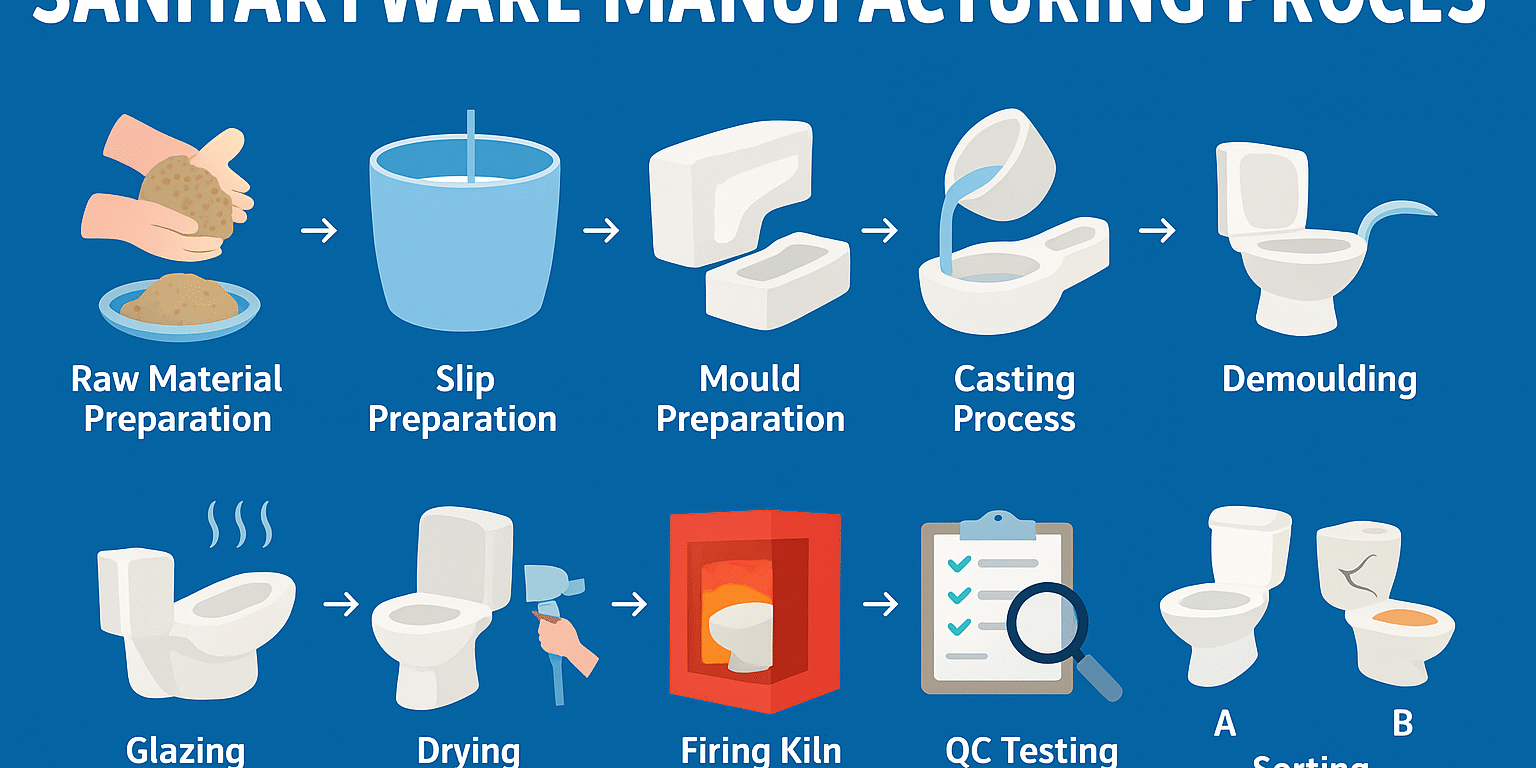
The sanitaryware manufacturing process begins with the careful selection and preparation of raw materials. Key ingredients such as ball clay, china clay (kaolin), feldspar, quartz, and other minerals are sourced and tested for purity, whiteness, plasticity, and consistency. These raw materials are weighed in exact proportions based on product requirements. Proper material selection is critical because it directly influences the strength, color, density, and glaze quality of the final product. Once prepared, the materials move to the grinding section for further processing.
Sanitaryware Raw Material Properties
1. Ball Clay
- Provides plasticity and workability
- Helps shape basins, toilets, and other sanitary products
2. China Clay (Kaolin)
- Increases whiteness and smoothness
- Improves strength of the final product
3. Quartz
- Reduces shrinkage during firing
- Gives hardness to sanitaryware
4. Feldspar
- Acts as a flux and helps materials fuse at high temperatures
- Improves glazing and smooth surface finish
5. Other Additives
- Stains, frits, binders, deflocculants
- Used to improve flow, colour, and final strength
The selected raw materials are mixed with water in ball mills to form a homogeneous slurry known as slip. This mixture undergoes continuous grinding, allowing the particles to achieve a fine texture and uniform consistency. After grinding, the slip is passed through magnetic separators to remove iron contamination and through sieves to eliminate coarse particles. The slip’s properties—such as viscosity, specific gravity, and fluidity—are adjusted to ensure it flows properly inside molds during casting. Proper slip preparation ensures defect-free shaping and stable final products.
Body Preparation Steps
Raw Material Crushing
- Raw materials are crushed into fine powder
- Ensures even particle distribution
Wet Grinding in Ball Mills
- Mixed with water to form a liquid slurry
- Produces uniform slip for casting
Sieving
- Removes impurities and oversized particles
- Ensures a smooth and refined mixture
Slip Adjustment
- Specific gravity, viscosity, and fluidity are adjusted
- Ensures perfect castability in molds
Sanitaryware products rely heavily on precise molds made from Plaster of Paris (POP). POP molds absorb moisture from the slip, allowing the ceramic body to form correctly. Each product, such as a basin or toilet bowl, may require multiple mould sections due to its complex geometry. The molds must be dried, cleaned, and maintained carefully before use to ensure accurate shapes and smooth finishes. A well-prepared mold guarantees consistency, dimensional accuracy, and reduced defects.
Material Used: Plaster of Paris (POP)
POP absorbs moisture quickly, making it ideal for casting
Mould Design & Carving
- Created in different parts for complex shapes
- Ensures precise geometry and dimensions
Mould Drying
- Must be properly dried before use
- Improves casting quality and reduces defects
In the casting stage, the prepared slip is poured into POP molds, allowing it to settle against the mold walls. As the POP absorbs water, a solid ceramic layer begins forming inside the cavity. The casting duration determines the wall thickness, which is monitored closely to match product standards. Once the desired thickness is achieved, the excess slip is drained from the mold. When the partially formed product reaches a semi-solid state, the mold is opened, and the cast piece known as “greenpiece” is gently removed. Casting defines the initial structure and shape of the sanitaryware item.
1. Pouring Slip into Mould
Slip fills the mold’s cavity completely
2. Wall Formation
Water is absorbed by POP.
A ceramic layer starts forming along the mould walls
3. Thickness Control
Casting time is monitored to reach standard thickness
4. Excess Slip Removal
Extra slip is drained to create the hollow body
5. De-moulding
Once set, the product is removed from the mould
Product at this stage is called “greenpiece”
After casting, greenware contains a high level of moisture and must undergo controlled drying. Initially, the products are allowed to air-dry naturally to remove surface moisture. They are later transferred to controlled drying chambers where temperature and humidity are monitored. This uniform drying is essential to prevent cracking, warping, or dimensional distortion. Proper drying strengthens the raw body and prepares it for trimming and finishing.
two different way to dry Green piece
Natural Drying
Air drying for initial moisture removal
Controlled Drying Chambers
Hot air drying to ensure uniform moisture removal
Prevents cracks, warping, and deformation
Once dried, the product undergoes manual and mechanical finishing to refine its shape and remove imperfections. Workers smoothen seams, correct edges, refine surfaces, and align functional areas such as trapways, outlet holes, and mounting points. Finishing also includes correcting dimensional variations and preparing the product for glazing. This meticulous stage ensures that the product meets design specifications and looks flawless before firing. After finishing, products move directly to the glazing section and then to the final firing kiln—eliminating the need for biscuit firing in modern plants.
Surface Smoothing
Uneven edges and seams are polished by hand or machine
Shape Corrections
Sharp edges, holes, and corners are refined
Quality Check Before Firing
Identifies cracks, dents, or shape issues
Ensures 100% defect-free pieces enter the kiln
The glazing stage provides sanitaryware with its smooth, glossy, and hygienic finish. A specially formulated glaze slurry containing frits, minerals, and pigments is applied to the dried body either manually, through spray booths, or using robotic glazing arms for consistent coating. The glaze adheres to the ceramic surface and forms a glass-like layer after firing. Proper glaze application ensures high gloss, scratch resistance, stain resistance, and a bright, uniform appearance. Once glazed, the product is ready for the final firing cycle.
Glaze Preparation process
Frits, stains, and chemicals mixed for shine and color
Glaze Application Methods
Manual glazing
Spray glazing
Robotic glazing for consistent quality
Drying
Ensures glaze attaches properly
Prevents glaze defects during firing
In modern sanitaryware manufacturing, products are subjected to a single high-temperature firing—also known as the once-fired or fast-firing process. The glazed body is placed inside tunnel or shuttle kilns and fired at temperatures ranging from 1180°C to 1220°C. During firing, the ceramic body vitrifies, becoming strong, dense, and impermeable, while the glaze melts and fuses to form a glossy surface. This firing process determines the product’s mechanical strength, water absorption levels, whiteness, and durability. Proper firing produces sanitaryware that is tough, hygienic, and long-lasting.
Temperature: 1200°C – 1300°C
Glaze melts and fuses to the ceramic body
Creates glassy, hygienic, and impermeable surface
Key Benefits
High shining
Zero water absorption
Scratch and stain resistance
After final firing and cooling, every sanitaryware product enters the sorting stage, where items are grouped based on quality, finish, and defects. Sorting ensures that only perfect pieces reach the market while minor-defect pieces are handled separately.
Sorting Parameter
1. Visual Surface Inspection
2. Dimensional & Shape Accuracy Check
3. Soundness / Tap Test
4. Glaze Smoothness Test
5. Colour & Gloss Uniformity Check
6. Pinholes & Hairline Crack Detection
7. Pinholes & Hairline Crack Detection
8. Sorting Into Grades: First Quality, Second Quality, Rejection
9. Marking & Traceability Tagging
10. Final Cleaning Before Packing
After firing, every sanitaryware product undergoes rigorous quality inspection following international standards such as IAPMO/UPC guidelines. Toilets are tested for vacuum seal retention, drainage performance, flush efficiency, waste clearance, structural strength, rim wash coverage, glazing quality, dimensional accuracy, water absorption, and noise levels. These tests ensure that each product meets global quality benchmarks and delivers reliable performance in real-world conditions. Defective pieces are rejected, and only fully compliant products proceed to the packaging stage.
testing checklist
1. Vacuum Test
Purpose:
..
Procedure:
…
Criteria:
…
2. Drainage Test
Purpose:
To ensure that the trapway and outlet allow smooth flow without blockage.
Procedure:
1 liter of water is poured through the trapway to check smooth flow.
A 25 mm diameter solid ball is passed through the trapway.
Pass Criteria:
Water must discharge smoothly.
Ball must pass without obstruction.
No choking or slow drainage.
3. Waste Clearance Test
Purpose:
To test flushing efficiency and bowl performance.
Procedure:
Use 350–500 grams of soybean paste or similar test media.
Perform a complete flush.
Pass Criteria:
Toilet must clear at least 75%–90% waste in one flush.
No residue or sticking on bowl surface.
4. Ball Test
Purpose:
To check trapway diameter and smoothness.
Procedure:
Flush with 50mm polyurethane balls (number based on model).
Pass Criteria:
All balls must pass smoothly.
No hang-ups or slow movement.
5. Flush Volume Test
Purpose:
To verify actual flush volume matches rated specification.
Procedure:
Fill tank to waterline.
Flush and collect water.
Measure discharge.
Pass Criteria:
Must operate at full flush (6L) or dual flush (3L/6L) as labelled.
Leakage must be zero.
6. Rim Wash Test
Purpose:
To check that rim jets wash the inner bowl surface properly.
Procedure:
Apply color dye inside bowl.
Flush once.
Pass Criteria:
95%+ area must be washed off in a single flush.
No dry spots on bowl.
7. Flush Power Test
Checks for:
Siphon formation
Jet pressure
Flushing force
Pass Criteria:
Strong siphon pull.
No slow swirling.
All solids must move without resistance.
8. Crack Test
Procedure:
Visual inspection under high-intensity light.
Tap test with ceramic/ iron hammer.
Surface checked for pinholes, hairline cracks, glaze defects.
Pass Criteria:
No cracks or weak points.
No glaze bubbles, waviness, or fish-scale defects.
9. Water Leakage Test
Procedure:
Fill bowl and tank.
Observe for 10–15 mins.
Pass Criteria:
Zero leakage from:
P-trap
Bowl
Tank joints
Flush seat area
10. Surface Smoothness Test
Checks:
Easy-to-clean glaze quality
Pass Criteria:
Smooth, uniform glaze without pores.
11. Dimensional Accuracy Test
Measured using templates & tools.
Pass Criteria:
Size tolerance within ±2 to ±4 mm
Installation holes properly aligned
Outlet dimension as per standard
12. Water Absorption Test
Purpose:
To ensure the ceramic body is fully vitrified.
Pass Criteria:
Water absorption must be < 0.5% (IAPMO requirement)
13. Colour, Gloss & Uniformity Test
Checks:
Colour consistency
Batch colour matching
14. Dunt Test
15. Rocking Test
16. Splash Test
17. Granule test
18. DYE Test
19. Crazing Test
20. Overflow test
21. Structure Integrity/ load Test
22. Trap seal depth determination Test
23. House hold Chemical test
24. Stain Resistance Test
Approved products are carefully packed using bubble sheets, foam corners, cardboard boxes, and protective shrink wraps. The packing team ensures each product is secure against vibration, impact, and friction during transport. Labels such as product name, model number, color, QC batch, and barcode are applied for easy identification. High-quality packing reduces breakage and ensures safe delivery to distributors and retailers.
Packed items are moved to the dispatch area where they are scanned, documented, and loaded systematically into trucks or containers. Proper stacking, palletizing, and load balancing prevent damage during transportation. Shipping schedules, route planning, and delivery coordination ensure timely supply to domestic and international markets. This final step completes the manufacturing cycle and delivers high-quality sanitaryware to customers worldwide.
Q1. What materials are used to make sanitaryware?
Sanitaryware is made from ball clay, china clay, feldspar, quartz, and glaze materials.
Q2. What is the firing temperature in sanitaryware production?
Sanitaryware is fired at 1200–1300°C.
Q3. What are the main steps of sanitaryware manufacturing?
Raw material prep → Slip → Moulding → Casting → Drying → Finishing → Glazing → Final firing → Inspection → Packaging.
Q4. How long does it take to manufacture sanitaryware?
From raw material to finished product, it may take 15–25 days depending on size and firing schedule.
Q5. What tests are done before dispatch?
Vacuum test, drainage test, waste clearing test, water seal depth, and glaze inspection.

15win4… short, sweet, and to the point. Does the site match the name, tho’? Only one way to fine out! Let’s visit! 15win4
Hey guys, Just heard of maxvina for first time and looks worth the hype. Anyone else checked it out before?
Mexboxcasino is pretty fun, especially if you like slots. The site’s pretty easy to navigate too. You should try: mexboxcasino
585betlogin’s site is pretty straightforward. Easy to find what you’re looking for, and the login process is simple enough. If you like no-nonsense platforms, give it a try. Access it here: 585betlogin
Just spent a few hours on zk88game. Some cool and new games I hadn’t seen before. The graphics are good, too. Might be my new go-to place. You can check them out: zk88game
Been using ph3655 for a bit now. Haven’t had any major issues. Site’s stable, and I appreciate the variety of options they have. Good overall in my opinion. Check their homepage: ph3655
Just wanted to drop a quick note to say how helpful this post was for my research. It is refreshing to read such a well written perspective that actually addresses the questions users have. I will definitely be coming back for more updates aipilotreview
Trying out Sprunki Cruel Sinda right now. That beat drop in the middle is fire! Love how the characters react to the rhythm. Definitely my new favorite phase.
NGL, Sprunki Hyper Shifted Phase 3 is low-key sus in the best way possible. The glitch effects are so well-done and they don’t break the game. Total masterpiece!
555win12… not gonna lie, the name is a bit weird, but the site’s not bad! Found some interesting games there. Worth a peek if you’re looking for something different. Find out more: 555win12
Hey, I’ve been checking out df99 and it seems pretty legit! Anyone else tried their platform? Thinking of throwing a few bucks I have online at df99 and see what’s up.
Anyone else using tl88? I appreciate their quick payouts, never had any issues there. Game variety could be better but they have some popular titles. Here’s the link: tl88